
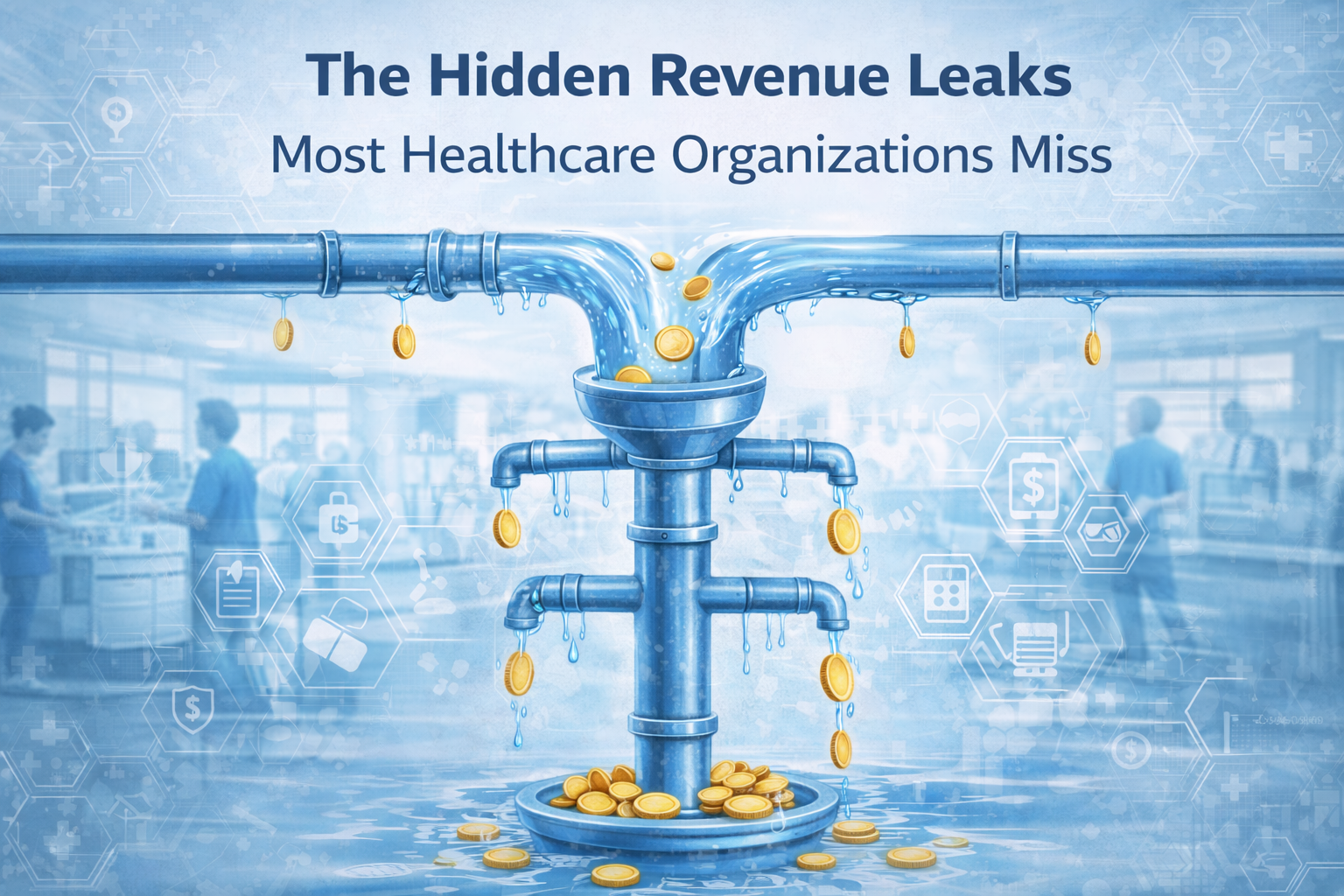
Most healthcare leaders understand that margins are tight. They review operating statements monthly. They track net revenue, denials, days in accounts receivable, and cost per encounter. Yet despite this oversight, many organizations continue to experience unexplained financial pressure. Revenue feels inconsistent. Cash flow feels unpredictable. Growth feels constrained.
The uncomfortable truth is that revenue loss in healthcare rarely happens through a single catastrophic failure. It happens quietly. It happens incrementally and it often hides in plain sight.
The most damaging revenue leaks are not dramatic. They are embedded in routine workflows, normalized by long-standing habits, and masked by acceptable performance averages. Over time, these leaks erode financial stability, limit reinvestment, and create a false narrative that external forces alone are responsible for financial strain.
In reality, much of the loss originates internally.
Revenue Leakage Begins Before the Claim Is Filed
Many organizations focus on the billing office when revenue drops. They scrutinize denial rates, clean claim percentages, and collection ratios. Those metrics are important, but they are downstream indicators. By the time a claim is denied or underpaid, the revenue damage has often already occurred.
Revenue leakage frequently begins at the point of access. Incomplete eligibility verification, inaccurate demographic capture, and inconsistent authorization processes create vulnerabilities before care is even delivered. These errors do not always generate obvious red flags. Instead, they result in delayed claims, partial payments, and preventable write-offs that blend into operational noise.
When access processes are not standardized and monitored with discipline, organizations unknowingly accept a level of financial risk that compounds daily. Small inaccuracies multiplied across thousands of encounters translate into significant revenue erosion over the course of a fiscal year.
Documentation Gaps That No One Sees
Clinical documentation is one of the most underestimated contributors to revenue loss. Not because physicians fail to document care, but because documentation often fails to reflect the full complexity and medical necessity of the services provided.
Under-documentation leads to under-coding. Under-coding leads to underpayment. These losses are rarely recovered because they do not trigger denials they simply reduce reimbursement quietly. Over time, this creates a structural underperformance that leadership may misinterpret as payer compression or market pressure.
On the other side of the spectrum, inconsistent documentation can also generate compliance risk. Revenue integrity is not about maximizing payment at any cost. It is about aligning documentation, coding, and billing with the true level of care delivered. When that alignment is absent, organizations either leave revenue on the table or expose themselves to audit vulnerability.
Without systematic auditing and feedback loops, these gaps remain invisible.
Charge Capture That Assumes Perfection
Charge capture processes are often built on trust. Organizations assume that services rendered are services billed. In reality, clinical workflows are complex, and handoffs between departments introduce risk.
Missed procedures, unbilled supplies, incorrectly linked diagnoses, and outdated charge description masters are common sources of revenue leakage. These issues do not always surface in high-level financial reporting because they represent revenue that was never recorded, not revenue that was denied.
Technology does not eliminate this risk. Electronic health records and practice management systems depend on accurate configuration and consistent user behavior. If templates are outdated or if workflows have evolved without parallel system updates, charge capture errors become institutionalized.
Revenue integrity requires continuous validation that what is performed clinically is accurately reflected financially. Without that validation, leakage becomes normalized.
Contractual Underpayments That Go Unchallenged
Payer contracts are negotiated with precision, yet many organizations fail to monitor payments with equal rigor. Underpayments frequently occur not because payers act maliciously, but because contract terms are complex, coding interpretations vary, and system logic is imperfect.
When organizations lack automated contract modeling and reconciliation processes, underpayments slip through. A single underpaid claim may not justify appeal effort. However, systemic underpayment across service lines can represent significant financial loss over time.
Leaders often assume that if payments are received, they are correct. That assumption is costly. Without detailed contract management and payment validation, organizations operate with incomplete financial intelligence.
Denials That Reflect Prevention Failures
Denial management departments often measure success by appeal recovery rates. While recovery is important, it does not address the underlying issue. Denials are rarely random. They are symptoms of upstream misalignment.
When denial trends persist month after month, they signal structural weaknesses. Repeated medical necessity denials may indicate documentation gaps. Authorization denials may point to front-end breakdowns. Coding denials may reflect inadequate education or unclear standards.
Organizations that treat denials solely as accounts to be worked miss the opportunity to correct systemic flaws. The cost of rework, both financial and human, is significant. Staff spend hours correcting preventable errors while leadership absorbs the impact in delayed cash flow and increased administrative expense.
True revenue integrity shifts the focus from recovery to prevention.
The Quiet Impact of Patient Responsibility
As deductibles and coinsurance obligations increase, patient responsibility represents a growing portion of revenue. Yet many organizations still approach patient collections reactively. Statements are mailed. Follow-up occurs late. Financial counseling is limited.
When patients do not understand their financial responsibility before services are rendered, collection likelihood decreases. Confusion leads to delay. Delay leads to bad debt. Over time, this becomes a material contributor to revenue leakage.
Transparent financial communication, point-of-service collection strategies, and early engagement significantly improve outcomes. Organizations that ignore this area often experience escalating write-offs that feel external but are operationally influenced.
Data That Fails to Tell the Full Story
Healthcare leaders are not short on dashboards. The challenge is not data scarcity but data clarity. Many revenue cycle reports focus on lagging indicators days in accounts receivable, denial rates, net collection percentages without illuminating root causes.
When metrics are viewed in isolation, revenue leakage can remain hidden behind acceptable averages. For example, a stable net collection rate may conceal service-line underperformance. An improving denial rate may mask growing under-coding trends.
Revenue integrity requires a deeper analytical lens. It demands connecting operational processes with financial outcomes. Without that integration, leadership may believe performance is stable while incremental losses accumulate beneath the surface.
Culture as a Financial Control
One of the most overlooked contributors to revenue leakage is organizational culture. When departments operate in silos, accountability diffuses. Access teams focus on scheduling volume. Clinical teams focus on care delivery. Billing teams focus on claim submission. Finance focuses on reporting outcomes.
Revenue integrity requires shared ownership. Every touchpoint in the patient journey influences financial performance. When teams understand that connection and operate with aligned incentives, leakage declines. When alignment is absent, each department optimizes locally while the organization absorbs global loss.
Financial stability is not achieved solely through policy or technology. It is sustained through a disciplined operational culture.
The Cost of Complacency
Perhaps the most dangerous revenue leak is complacency. When organizations accept a certain level of write-offs, denials, and underpayments as inevitable, improvement stalls. Leaders may rationalize losses as industry norms or payer behavior beyond control.
While external pressures are real, internal process control remains one of the few levers healthcare organizations can actively manage. Those who regularly evaluate workflows, audit compliance, and measure performance at granular levels consistently outperform peers who rely on surface-level reporting.
Revenue integrity is not a one-time initiative. It is an ongoing discipline.
Why Revenue Leaks Matter More Than Ever
In previous decades, margin compression could be offset by volume growth. That cushion has narrowed. Labor costs have risen. Regulatory complexity has increased. Payer scrutiny has intensified. Capital investments are more expensive.
In this environment, hidden revenue leakage is no longer tolerable. Even modest percentage losses translate into millions of dollars for mid-sized organizations. That revenue represents staffing capacity, technology upgrades, service expansion, and community investment.
The organizations that remain financially resilient are not necessarily those with the best payer mix or the largest scale. They are those that relentlessly protect revenue already earned.